How to play
You complete Zerline when all 104 cards complete the eight thirteen-card King-to-Queen wrapped suited foundations. The full Zerline position determines the outcome; visual shortcuts never replace the documented Zerline terminal rule.
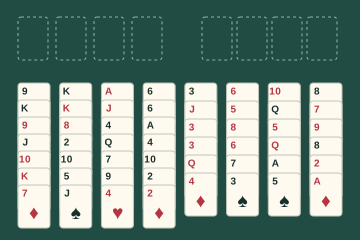
- Zerline begins with two decks spread into eight working columns and a four-card reserve beside eight empty King-start foundation cycles. The Zerline deal identity and PySolFC Zerline v1 are stored together. Restarting Zerline reproduces this opening exactly.
- During Zerline, you build legal tableau sequences, use reserve capacity, place only Queens into empty columns, and advance suited foundations from King through wrapped ranks to Queen. The Zerline engine rejects profile violations, unavailable material, and every action attempted after Zerline reaches a terminal result.
- You complete Zerline when all 104 cards complete the eight thirteen-card King-to-Queen wrapped suited foundations. The full Zerline position determines the outcome; visual shortcuts never replace the documented Zerline terminal rule.
Strategy tips
- A reliable Zerline plan is to preserve accessible Queens as vacancy keys and avoid filling all four reserve positions with cards that cannot immediately rejoin a column. A Zerline hint is legal and deterministic. The next Zerline hint exposes one bounded action; it never claims a forced Zerline win.
- A costly Zerline mistake is to place a King into empty tableau space by ordinary patience convention; Zerline reserves empties specifically for Queens. Undo supports studying that Zerline decision, while restart preserves the original seeded Zerline opening.
- In the Zerline endgame, free the last Queens before closing their foundation cycles and use reserve slots to separate duplicate suit copies near the wrap. Check every remaining Zerline action before committing because its terminal rule is enforced immediately.