Wheatsheaf

You complete Wheatsheaf when both decks are divided completely among the eight suited foundations after all auto-filled columns and waste cards are cleared. The full Wheatsheaf position determines the outcome; visual shortcuts never replace the documented Wheatsheaf terminal rule.

Loading game

Stats on this device

Your unfinished game is saved only in this browser.

Played
0
Wins
0
Win rate
Fastest win
Fewest moves
Best score
Current streak
0 days
Best streak
0 days

How to play

You complete Wheatsheaf when both decks are divided completely among the eight suited foundations after all auto-filled columns and waste cards are cleared. The full Wheatsheaf position determines the outcome; visual shortcuts never replace the documented Wheatsheaf terminal rule.

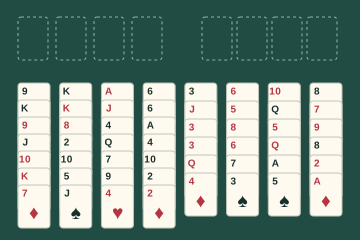
  • Wheatsheaf begins with eight working columns, paired Ace-up and King-down suited foundations, one waste, and a stock responsible for every automatic refill. The Wheatsheaf deal identity and PySolFC Wheatsheaf v1 are stored together. Restarting Wheatsheaf reproduces this opening exactly.
  • During Wheatsheaf, you place a same-suit adjacent rank in either direction on tableau, move exposed tops to the matching foundation, draw, and accept stock refill of empty columns. The Wheatsheaf engine rejects profile violations, unavailable material, and every action attempted after Wheatsheaf reaches a terminal result.
  • You complete Wheatsheaf when both decks are divided completely among the eight suited foundations after all auto-filled columns and waste cards are cleared. The full Wheatsheaf position determines the outcome; visual shortcuts never replace the documented Wheatsheaf terminal rule.

Strategy tips

  • A reliable Wheatsheaf plan is to choose a direction for each tableau suit chain and empty a column only when the next forced stock card has a known route. A Wheatsheaf hint is legal and deterministic. The next Wheatsheaf hint exposes one bounded action; it never claims a forced Wheatsheaf win.
  • A costly Wheatsheaf mistake is to reverse a chain repeatedly without considering automatic refill; the temporary vacancy disappears as soon as stock can supply it. Undo supports studying that Wheatsheaf decision, while restart preserves the original seeded Wheatsheaf opening.
  • In the Wheatsheaf endgame, bring ascending and descending foundations toward the middle ranks while using the final forced fills to bridge remaining same-suit gaps. Check every remaining Wheatsheaf action before committing because its terminal rule is enforced immediately.
Complete guide

Rules, scoring, and strategy

Wheatsheaf uses the independently implemented PySolFC Wheatsheaf v1 profile (R310). Wheatsheaf is a complete deterministic browser game built around automatically replenished Congress-style columns that build up or down by suit between four ascending and four descending foundations.

Setup and opening position

Wheatsheaf begins with eight working columns, paired Ace-up and King-down suited foundations, one waste, and a stock responsible for every automatic refill. The Wheatsheaf deal identity and PySolFC Wheatsheaf v1 are stored together. Restarting Wheatsheaf reproduces this opening exactly.

Legal moves and game flow

During Wheatsheaf, you place a same-suit adjacent rank in either direction on tableau, move exposed tops to the matching foundation, draw, and accept stock refill of empty columns. The Wheatsheaf engine rejects profile violations, unavailable material, and every action attempted after Wheatsheaf reaches a terminal result.

Winning and terminal positions

You complete Wheatsheaf when both decks are divided completely among the eight suited foundations after all auto-filled columns and waste cards are cleared. The full Wheatsheaf position determines the outcome; visual shortcuts never replace the documented Wheatsheaf terminal rule. In the Wheatsheaf endgame, bring ascending and descending foundations toward the middle ranks while using the final forced fills to bridge remaining same-suit gaps. Check every remaining Wheatsheaf action before committing because its terminal rule is enforced immediately.

Practical strategy

A reliable Wheatsheaf plan is to choose a direction for each tableau suit chain and empty a column only when the next forced stock card has a known route. A Wheatsheaf hint is legal and deterministic. The next Wheatsheaf hint exposes one bounded action; it never claims a forced Wheatsheaf win. A costly Wheatsheaf mistake is to reverse a chain repeatedly without considering automatic refill; the temporary vacancy disappears as soon as stock can supply it. Undo supports studying that Wheatsheaf decision, while restart preserves the original seeded Wheatsheaf opening.

Questions players ask

What makes Wheatsheaf a separate game?

Wheatsheaf uses automatically replenished Congress-style columns that build up or down by suit between four ascending and four descending foundations. That rule belongs to the Wheatsheaf engine and storage identity rather than a cosmetic preset.

Which edge rule matters most in Wheatsheaf?

Tableau piles build by same suit in either rank direction, and any empty pile is automatically refilled while stock remains.

How is a Wheatsheaf position reproduced?

Wheatsheaf records its game ID, rules version, and seeded deal identity. Those Wheatsheaf values recreate the same opening without a server request.