Twenty

Complete Twenty when every card reaches a legal foundation under its suit, base, direction, capacity and source restrictions. The engine checks the full card partition and terminal rule rather than a visual approximation.

Loading game

Stats on this device

Your unfinished game is saved only in this browser.

Played
0
Wins
0
Win rate
Fastest win
Fewest moves
Best score
Current streak
0 days
Best streak
0 days

How to play

Complete Twenty when every card reaches a legal foundation under its suit, base, direction, capacity and source restrictions. The engine checks the full card partition and terminal rule rather than a visual approximation.

  • Twenty reconstructs its exact pile counts, concealed-card mask, seeded foundations and stock remainder from the route seed. The stock deals bounded rows of at most 20 cards under the profile's vacancy gates. Restart reproduces the same deal locally without a network request.
  • A move is accepted only when its source is exposed, its packet satisfies any, and its destination satisfies none plus the any vacancy gate. Invalid, stale, non-finite and post-terminal actions do not mutate state.
  • Complete Twenty when every card reaches a legal foundation under its suit, base, direction, capacity and source restrictions. The engine checks the full card partition and terminal rule rather than a visual approximation.

Strategy tips

  • In Twenty, map foundation dependencies before committing a reversible-looking tableau transfer. Twenty top-only slots refill from stock and feed four Ace-up plus four King-down suit foundations; tableau cards never build on one another and the last stock row may be partial.
  • The most common Twenty error is advancing a foundation before checking whether its card is still needed in the tableau; the move may be legal in a neighbouring family while being rejected or strategically fatal in this exact profile.
  • Before the final commitment in Twenty, count every live card, locked source and legal destination. Confirm that every card reaches a legal foundation under its suit, base, direction, capacity and source restrictions.
Complete guide

Rules, scoring, and strategy

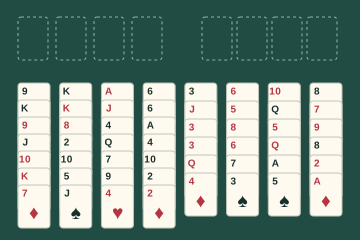
Twenty uses the independently implemented Twenty PySolFC 3.6.1 fixed rules v1 profile (R896). Twenty is an independently versioned browser card game defined by this source-audited rule: Twenty top-only slots refill from stock and feed four Ace-up plus four King-down suit foundations; tableau cards never build on one another and the last stock row may be partial.

Setup and opening position

Twenty reconstructs its exact pile counts, concealed-card mask, seeded foundations and stock remainder from the route seed. The stock deals bounded rows of at most 20 cards under the profile's vacancy gates. Restart reproduces the same deal locally without a network request.

Legal moves and game flow

A move is accepted only when its source is exposed, its packet satisfies any, and its destination satisfies none plus the any vacancy gate. Invalid, stale, non-finite and post-terminal actions do not mutate state.

Winning and terminal positions

Complete Twenty when every card reaches a legal foundation under its suit, base, direction, capacity and source restrictions. The engine checks the full card partition and terminal rule rather than a visual approximation. Before the final commitment in Twenty, count every live card, locked source and legal destination. Confirm that every card reaches a legal foundation under its suit, base, direction, capacity and source restrictions.

Practical strategy

In Twenty, map foundation dependencies before committing a reversible-looking tableau transfer. Twenty top-only slots refill from stock and feed four Ace-up plus four King-down suit foundations; tableau cards never build on one another and the last stock row may be partial. The most common Twenty error is advancing a foundation before checking whether its card is still needed in the tableau; the move may be legal in a neighbouring family while being rejected or strategically fatal in this exact profile.

Questions players ask

Why is Twenty a separate game?

Twenty has its own engine ID, save namespace and rules fingerprint because Twenty top-only slots refill from stock and feed four Ace-up plus four King-down suit foundations; tableau cards never build on one another and the last stock row may be partial.

What should I check before moving in Twenty?

Check source exposure, packet integrity, the exact vacancy gate and the next forced stock or reserve consequence; then map foundation dependencies before committing a reversible-looking tableau transfer.

Is every Twenty deal guaranteed winnable?

No. The seed guarantees reproducibility and the engine guarantees legal transitions, but the catalog does not make an unsupported claim that every shuffled deal is solvable.