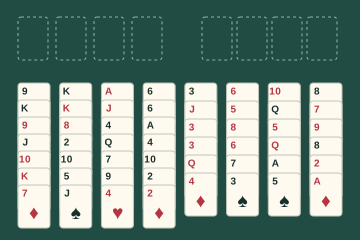
Setup and opening position
Ten tableau columns hold four or five cards with only their tops face up, ten one-card trap reserves stand above them, and fifty cards remain in stock.
Remove both decks as eight same-suit thirteen-card King-to-Ace packets.
Your unfinished game is saved only in this browser.
Remove both decks as eight same-suit thirteen-card King-to-Ace packets.
Complete guide
Trapdoor Spider is a complete browser implementation with its own versioned rules profile. Release ten trap cards onto covered rank-building columns while preserving suited movable runs and eight automatic Spider packets.
Ten tableau columns hold four or five cards with only their tops face up, ten one-card trap reserves stand above them, and fifty cards remain in stock.
Tableau builds downward by rank regardless of suit, but a multi-card tail moves only when descending in one suit. A trap card may move to a legal tableau pile. Releasing the traps places all ten reserve cards on their paired columns, then refills the reserves from stock; complete suited King-to-Ace runs remove automatically.
Remove both decks as eight same-suit thirteen-card King-to-Ace packets. Use the final trap release only after exposing stable suited descents, then complete packets to create space for the remaining hidden layers.
Clear suited tails before releasing a reserve row, and inspect all ten trap cards so their paired placement does not bury several nearly complete sequences. A mixed-suit rank run can be built but cannot move as a packet, and releasing traps affects every column rather than only the convenient reserve.
Remove both decks as eight same-suit thirteen-card King-to-Ace packets.
Tableau builds downward by rank regardless of suit, but a multi-card tail moves only when descending in one suit. A trap card may move to a legal tableau pile. Releasing the traps places all ten reserve cards on their paired columns, then refills the reserves from stock; complete suited King-to-Ace runs remove automatically.
Clear suited tails before releasing a reserve row, and inspect all ten trap cards so their paired placement does not bury several nearly complete sequences.