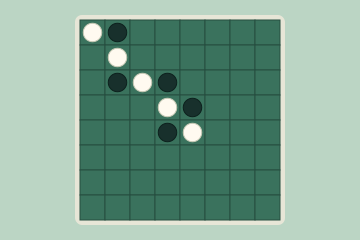
Setup and opening position
Each side fills the two rows nearest it with twelve pieces, leaving the middle two rows empty. Two concentric loop circuits connect selected interior rows and columns around all four corners.
Capture all twelve opposing pieces while keeping your own pieces connected to useful loop-entry tracks.
Your unfinished game is saved only in this browser.
Capture all twelve opposing pieces while keeping your own pieces connected to useful loop-entry tracks.
Complete guide
Surakarta is a complete browser implementation with its own versioned rules profile. Reposition twelve pieces on a six-by-six grid, then strike along clear orthogonal tracks that curl through the board's distinctive corner loops.
Each side fills the two rows nearest it with twelve pieces, leaving the middle two rows empty. Two concentric loop circuits connect selected interior rows and columns around all four corners.
A normal move goes one point in any of eight directions to an empty neighbor. A capture instead follows rows, columns, and at least one complete loop; every passed point must be empty, and the first encountered piece must be an enemy.
Capture all twelve opposing pieces while keeping your own pieces connected to useful loop-entry tracks. With only a few targets left, guard the first occupied point on each circuit: a farther enemy is safe whenever any friendly or enemy piece blocks the track before it.
Move pieces from corners toward the four inner ranks and files that feed the circuits. Before attacking, trace both directions because a friendly blocker ends the route while a second loop can reach a distant target. A straight orthogonal line does not capture by itself, diagonals are only for ordinary one-step moves, and no loop path may jump over either color.
Capture all twelve opposing pieces while keeping your own pieces connected to useful loop-entry tracks.
A normal move goes one point in any of eight directions to an empty neighbor. A capture instead follows rows, columns, and at least one complete loop; every passed point must be empty, and the first encountered piece must be an enemy.
Move pieces from corners toward the four inner ranks and files that feed the circuits. Before attacking, trace both directions because a friendly blocker ends the route while a second loop can reach a distant target.