Sixes and Sevens

You complete Sixes and Sevens when every suit-copy foundation completes its fixed Six-to-Ace or Seven-to-King direction before stock and spaces are exhausted. The full Sixes and Sevens position determines the outcome; visual shortcuts never replace the documented Sixes and Sevens terminal rule.

Loading game

Stats on this device

Your unfinished game is saved only in this browser.

Played
0
Wins
0
Win rate
Fastest win
Fewest moves
Best score
Current streak
0 days
Best streak
0 days

How to play

You complete Sixes and Sevens when every suit-copy foundation completes its fixed Six-to-Ace or Seven-to-King direction before stock and spaces are exhausted. The full Sixes and Sevens position determines the outcome; visual shortcuts never replace the documented Sixes and Sevens terminal rule.

  • Sixes and Sevens begins with all Sixes and Sevens already placed on sixteen foundations, nine exposed spaces, one waste, and remaining cards in a single-pass stock. The Sixes and Sevens deal identity and PySolFC Sixes and Sevens v1 are stored together. Restarting Sixes and Sevens reproduces this opening exactly.
  • During Sixes and Sevens, you send lower same-suit ranks from Six down to Ace, higher same-suit ranks from Seven up to King, draw stock, and refill empty spaces automatically. The Sixes and Sevens engine rejects profile violations, unavailable material, and every action attempted after Sixes and Sevens reaches a terminal result.
  • You complete Sixes and Sevens when every suit-copy foundation completes its fixed Six-to-Ace or Seven-to-King direction before stock and spaces are exhausted. The full Sixes and Sevens position determines the outcome; visual shortcuts never replace the documented Sixes and Sevens terminal rule.

Strategy tips

  • A reliable Sixes and Sevens plan is to balance both directions for each suit and use a vacancy to expose the exact Five or Eight that unlocks a longer chain. A Sixes and Sevens hint is legal and deterministic. The next Sixes and Sevens hint exposes one bounded action; it never claims a forced Sixes and Sevens win.
  • A costly Sixes and Sevens mistake is to cross a middle card to the wrong base; Fives belong below Six and Eights above Seven, with no foundation wrap or reversal. Undo supports studying that Sixes and Sevens decision, while restart preserves the original seeded Sixes and Sevens opening.
  • In the Sixes and Sevens endgame, close the shorter low-rank paths first and preserve space for high cards that arrive late in the one-pass stock. Check every remaining Sixes and Sevens action before committing because its terminal rule is enforced immediately.
Complete guide

Rules, scoring, and strategy

Sixes and Sevens uses the independently implemented PySolFC Sixes and Sevens v1 profile (R333). Sixes and Sevens is a complete deterministic browser game built around sixteen pre-positioned Six and Seven foundations, nine one-card spaces, no redeal, and opposite suited directions from adjacent middle ranks.

Setup and opening position

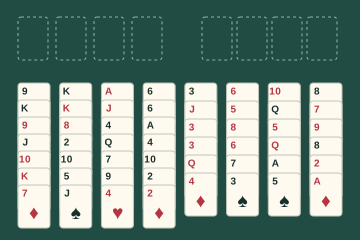
Sixes and Sevens begins with all Sixes and Sevens already placed on sixteen foundations, nine exposed spaces, one waste, and remaining cards in a single-pass stock. The Sixes and Sevens deal identity and PySolFC Sixes and Sevens v1 are stored together. Restarting Sixes and Sevens reproduces this opening exactly.

Legal moves and game flow

During Sixes and Sevens, you send lower same-suit ranks from Six down to Ace, higher same-suit ranks from Seven up to King, draw stock, and refill empty spaces automatically. The Sixes and Sevens engine rejects profile violations, unavailable material, and every action attempted after Sixes and Sevens reaches a terminal result.

Winning and terminal positions

You complete Sixes and Sevens when every suit-copy foundation completes its fixed Six-to-Ace or Seven-to-King direction before stock and spaces are exhausted. The full Sixes and Sevens position determines the outcome; visual shortcuts never replace the documented Sixes and Sevens terminal rule. In the Sixes and Sevens endgame, close the shorter low-rank paths first and preserve space for high cards that arrive late in the one-pass stock. Check every remaining Sixes and Sevens action before committing because its terminal rule is enforced immediately.

Practical strategy

A reliable Sixes and Sevens plan is to balance both directions for each suit and use a vacancy to expose the exact Five or Eight that unlocks a longer chain. A Sixes and Sevens hint is legal and deterministic. The next Sixes and Sevens hint exposes one bounded action; it never claims a forced Sixes and Sevens win. A costly Sixes and Sevens mistake is to cross a middle card to the wrong base; Fives belong below Six and Eights above Seven, with no foundation wrap or reversal. Undo supports studying that Sixes and Sevens decision, while restart preserves the original seeded Sixes and Sevens opening.

Questions players ask

What makes Sixes and Sevens a separate game?

Sixes and Sevens uses sixteen pre-positioned Six and Seven foundations, nine one-card spaces, no redeal, and opposite suited directions from adjacent middle ranks. That rule belongs to the Sixes and Sevens engine and storage identity rather than a cosmetic preset.

Which edge rule matters most in Sixes and Sevens?

Six foundations descend only to Ace and Seven foundations ascend only to King; cards cannot switch direction or return.

How is a Sixes and Sevens position reproduced?

Sixes and Sevens records its game ID, rules version, and seeded deal identity. Those Sixes and Sevens values recreate the same opening without a server request.