Phoenix

Complete Phoenix when all cards have reached foundations in the profile's required rank, suit, colour, direction, source and capacity order. The runtime checks the entire position rather than a visual approximation or an unsupported solvability claim.

Loading game

Stats on this device

Your unfinished game is saved only in this browser.

Played
0
Wins
0
Win rate
Fastest win
Fewest moves
Best score
Current streak
0 days
Best streak
0 days

How to play

Complete Phoenix when all cards have reached foundations in the profile's required rank, suit, colour, direction, source and capacity order. The runtime checks the entire position rather than a visual approximation or an unsupported solvability claim.

  • Phoenix reconstructs its published opening from the route ID, rules version and local seed. Fixed clues, hidden cards and editable decisions remain separate, and restart reproduces the same position without a network request.
  • A transfer is legal only under eight foundations split between upward and downward suit streams while twelve nonbuilding reserves expose a fixed two-deck queue from both rank directions. Invalid, stale, non-finite and post-terminal actions leave the state and undo history unchanged.
  • Complete Phoenix when all cards have reached foundations in the profile's required rank, suit, colour, direction, source and capacity order. The runtime checks the entire position rather than a visual approximation or an unsupported solvability claim.

Strategy tips

  • Solve Phoenix from fixed information outward, revisiting distant effects whenever the defining interaction changes. Eight foundations split between upward and downward suit streams while twelve nonbuilding reserves expose a fixed two-deck queue from both rank directions.
  • A partial pattern in Phoenix may look complete while a remote pile, cell, edge, room or clue still contradicts the profile.
  • Near the end of Phoenix, count every unresolved destination or constraint before committing a narrow move. Use undo to compare legal branches, then recheck that all cards have reached foundations in the profile's required rank, suit, colour, direction, source and capacity order.
Complete guide

Rules, scoring, and strategy

Phoenix uses the independently implemented Phoenix PySolFC 3.6.1 fixed rules v1 profile (R687). Phoenix is an independently versioned browser game centred on Eight foundations split between upward and downward suit streams while twelve nonbuilding reserves expose a fixed two-deck queue from both rank directions.

Setup and opening position

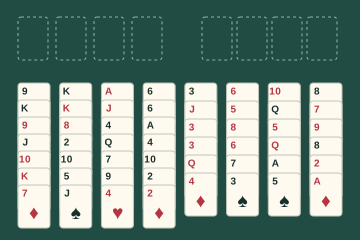
Phoenix reconstructs its published opening from the route ID, rules version and local seed. Fixed clues, hidden cards and editable decisions remain separate, and restart reproduces the same position without a network request.

Legal moves and game flow

A transfer is legal only under eight foundations split between upward and downward suit streams while twelve nonbuilding reserves expose a fixed two-deck queue from both rank directions. Invalid, stale, non-finite and post-terminal actions leave the state and undo history unchanged.

Winning and terminal positions

Complete Phoenix when all cards have reached foundations in the profile's required rank, suit, colour, direction, source and capacity order. The runtime checks the entire position rather than a visual approximation or an unsupported solvability claim. Near the end of Phoenix, count every unresolved destination or constraint before committing a narrow move. Use undo to compare legal branches, then recheck that all cards have reached foundations in the profile's required rank, suit, colour, direction, source and capacity order.

Practical strategy

Solve Phoenix from fixed information outward, revisiting distant effects whenever the defining interaction changes. Eight foundations split between upward and downward suit streams while twelve nonbuilding reserves expose a fixed two-deck queue from both rank directions. A partial pattern in Phoenix may look complete while a remote pile, cell, edge, room or clue still contradicts the profile.

Questions players ask

Why is Phoenix counted separately?

Phoenix owns a separate engine ID, save key and rules profile because Eight foundations split between upward and downward suit streams while twelve nonbuilding reserves expose a fixed two-deck queue from both rank directions.

What should be checked before a Phoenix move?

Solve Phoenix from fixed information outward, revisiting distant effects whenever the defining interaction changes. Eight foundations split between upward and downward suit streams while twelve nonbuilding reserves expose a fixed two-deck queue from both rank directions. A transfer is legal only under eight foundations split between upward and downward suit streams while twelve nonbuilding reserves expose a fixed two-deck queue from both rank directions.

Does Phoenix promise a winnable deal?

No. Its seed reproduces the opening and its engine proves legal state transitions, but the catalog makes no unsupported claim that every shuffled deal is solvable.