Phalanx

The winning condition for Phalanx is precise: the triangular exposure graph and waste are cleared into the four foundations. No hidden solution values are printed to justify the result; the rules engine validates the submitted position.

Loading game

Stats on this device

Your unfinished game is saved only in this browser.

Played
0
Wins
0
Win rate
Fastest win
Fewest moves
Best score
Current streak
0 days
Best streak
0 days

How to play

The winning condition for Phalanx is precise: the triangular exposure graph and waste are cleared into the four foundations. No hidden solution values are printed to justify the result; the rules engine validates the submitted position.

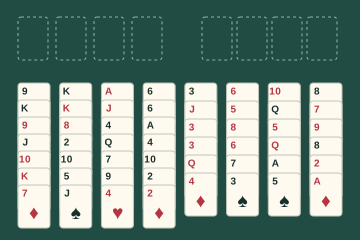
  • Before the first move in Phalanx, identify which marks are givens and which controls are decisions. Fifteen nonbuilding reserves form a triangular phalanx, and only exposed reserve or waste tops may move to four suit foundations. The browser stores that distinction with the seeded opening so a restart never changes the puzzle or deal.
  • Use the live board controls to change one legal decision at a time. Fifteen nonbuilding reserves form a triangular phalanx, and only exposed reserve or waste tops may move to four suit foundations. The runtime validates the resulting state before it records a move or opens a new undo branch.
  • The winning condition for Phalanx is precise: the triangular exposure graph and waste are cleared into the four foundations. No hidden solution values are printed to justify the result; the rules engine validates the submitted position.

Strategy tips

  • Trace which triangular reserve cards cover others and choose exposed moves that release two lower positions, since the nonbuilding reserves offer no rearrangement.
  • Planning to park a card on another reserve is impossible; every exposed card must already have a foundation or waste-supported escape route.
  • Use undo to compare the last branch if two completions look plausible, then recheck the exact requirement: the triangular exposure graph and waste are cleared into the four foundations. A locally attractive move can still break a distant constraint.
Complete guide

Rules, scoring, and strategy

Phalanx uses the independently implemented Phalanx PySolFC 3.6.1 fixed rules v1 profile (R626). Phalanx changes familiar play through a specific constraint: Fifteen nonbuilding reserves form a triangular phalanx, and only exposed reserve or waste tops may move to four suit foundations.

Setup and opening position

Before the first move in Phalanx, identify which marks are givens and which controls are decisions. Fifteen nonbuilding reserves form a triangular phalanx, and only exposed reserve or waste tops may move to four suit foundations. The browser stores that distinction with the seeded opening so a restart never changes the puzzle or deal.

Legal moves and game flow

Use the live board controls to change one legal decision at a time. Fifteen nonbuilding reserves form a triangular phalanx, and only exposed reserve or waste tops may move to four suit foundations. The runtime validates the resulting state before it records a move or opens a new undo branch.

Winning and terminal positions

The winning condition for Phalanx is precise: the triangular exposure graph and waste are cleared into the four foundations. No hidden solution values are printed to justify the result; the rules engine validates the submitted position. Use undo to compare the last branch if two completions look plausible, then recheck the exact requirement: the triangular exposure graph and waste are cleared into the four foundations. A locally attractive move can still break a distant constraint.

Practical strategy

Trace which triangular reserve cards cover others and choose exposed moves that release two lower positions, since the nonbuilding reserves offer no rearrangement. Planning to park a card on another reserve is impossible; every exposed card must already have a foundation or waste-supported escape route.

Questions players ask

How does play in Phalanx change when players account for triangular reserve exposure without building?

Trace which triangular reserve cards cover others and choose exposed moves that release two lower positions, since the nonbuilding reserves offer no rearrangement. This matters specifically because fifteen nonbuilding reserves form a triangular phalanx, and only exposed reserve or waste tops may move to four suit foundations.

Why can a locally legal-looking plan fail in Phalanx?

Planning to park a card on another reserve is impossible; every exposed card must already have a foundation or waste-supported escape route. Recheck the legal boundary before choosing a replacement move.

Which obligations must all agree at the end of Phalanx?

Success in Phalanx requires that the triangular exposure graph and waste are cleared into the four foundations. The game declares completion only after all interacting restrictions agree at the same time. Undo and redo expose alternative branches without revealing an authored answer.