Perseverance

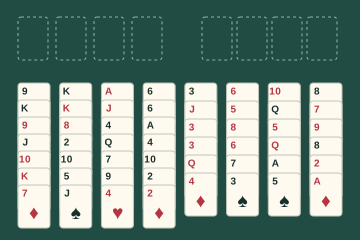
Success in Perseverance requires that all cards reach the foundations within the initial deal and two deterministic regrouping redeals. The game declares completion only after all interacting restrictions agree at the same time.

Loading game

Stats on this device

Your unfinished game is saved only in this browser.

Played
0
Wins
0
Win rate
Fastest win
Fewest moves
Best score
Current streak
0 days
Best streak
0 days

How to play

Success in Perseverance requires that all cards reach the foundations within the initial deal and two deterministic regrouping redeals. The game declares completion only after all interacting restrictions agree at the same time.

  • The Perseverance opening separates permanent constraints from player-controlled positions. Same-suit sequences may move between fans, followed by exactly two nonshuffling Cruel-style redeals that regroup remaining cards four at a time. Its versioned seed recreates those same constraints locally while keeping unrevealed decisions out of the guide and board labels.
  • Perseverance treats the printed or dealt restrictions as hard constraints, not suggestions. Same-suit sequences may move between fans, followed by exactly two nonshuffling Cruel-style redeals that regroup remaining cards four at a time. A move that contradicts the current state has no effect, including after the game has ended.
  • Success in Perseverance requires that all cards reach the foundations within the initial deal and two deterministic regrouping redeals. The game declares completion only after all interacting restrictions agree at the same time.

Strategy tips

  • Consolidate long same-suit descents before each Cruel regrouping and spend the two redeals only when several new foundation fronts will emerge together.
  • Expecting a shuffle from the regroup preserves false hope: the four-card packets retain order, so a buried conflict returns unless changed before collection.
  • Close Perseverance by auditing the boundary cases first and the obvious placements second. The position is not done until all cards reach the foundations within the initial deal and two deterministic regrouping redeals.
Complete guide

Rules, scoring, and strategy

Perseverance uses the independently implemented Perseverance PySolFC 3.6.1 fixed rules v1 profile (R607). The defining decisions in Perseverance come from this rules combination: Same-suit sequences may move between fans, followed by exactly two nonshuffling Cruel-style redeals that regroup remaining cards four at a time.

Setup and opening position

The Perseverance opening separates permanent constraints from player-controlled positions. Same-suit sequences may move between fans, followed by exactly two nonshuffling Cruel-style redeals that regroup remaining cards four at a time. Its versioned seed recreates those same constraints locally while keeping unrevealed decisions out of the guide and board labels.

Legal moves and game flow

Perseverance treats the printed or dealt restrictions as hard constraints, not suggestions. Same-suit sequences may move between fans, followed by exactly two nonshuffling Cruel-style redeals that regroup remaining cards four at a time. A move that contradicts the current state has no effect, including after the game has ended.

Winning and terminal positions

Success in Perseverance requires that all cards reach the foundations within the initial deal and two deterministic regrouping redeals. The game declares completion only after all interacting restrictions agree at the same time. Close Perseverance by auditing the boundary cases first and the obvious placements second. The position is not done until all cards reach the foundations within the initial deal and two deterministic regrouping redeals.

Practical strategy

Consolidate long same-suit descents before each Cruel regrouping and spend the two redeals only when several new foundation fronts will emerge together. Expecting a shuffle from the regroup preserves false hope: the four-card packets retain order, so a buried conflict returns unless changed before collection.

Questions players ask

Which decisions in Perseverance depend on two order-preserving Cruel redeals?

Consolidate long same-suit descents before each Cruel regrouping and spend the two redeals only when several new foundation fronts will emerge together. This matters specifically because same-suit sequences may move between fans, followed by exactly two nonshuffling Cruel-style redeals that regroup remaining cards four at a time.

What boundary should be rechecked after a mistake in Perseverance?

Expecting a shuffle from the regroup preserves false hope: the four-card packets retain order, so a buried conflict returns unless changed before collection. Recheck the legal boundary before choosing a replacement move.

When does the runtime award completion in Perseverance?

Finish Perseverance when all cards reach the foundations within the initial deal and two deterministic regrouping redeals. Completion is checked from the entire position, not from a displayed answer or a visual approximation. Undo and redo expose alternative branches without revealing an authored answer.