How to play
You complete Odd and Even when all cards complete their odd-rank or even-rank suited foundation cycles after no more than two stock passes. The full Odd and Even position determines the outcome; visual shortcuts never replace the documented Odd and Even terminal rule.
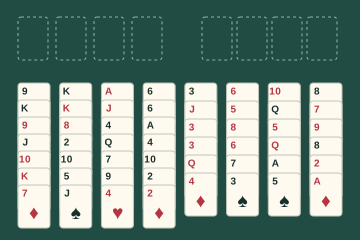
- Odd and Even begins with nine exposed spaces, paired odd and even suited foundations, a stock/waste pair, and one ordered redeal. The Odd and Even deal identity and PySolFC Odd and Even v1 are stored together. Restarting Odd and Even reproduces this opening exactly.
- During Odd and Even, you move an exposed space or waste card to the next same-suit foundation rank two steps away, draw stock, and accept automatic refill of vacancies. The Odd and Even engine rejects profile violations, unavailable material, and every action attempted after Odd and Even reaches a terminal result.
- You complete Odd and Even when all cards complete their odd-rank or even-rank suited foundation cycles after no more than two stock passes. The full Odd and Even position determines the outcome; visual shortcuts never replace the documented Odd and Even terminal rule.
Strategy tips
- A reliable Odd and Even plan is to track the two-step successor for every exposed card and clear a space only when its automatic replacement also has a likely foundation route. A Odd and Even hint is legal and deterministic. The next Odd and Even hint exposes one bounded action; it never claims a forced Odd and Even win.
- A costly Odd and Even mistake is to look for ordinary adjacent foundation ranks; each lane skips one rank and keeps odd and even sequences separate. Undo supports studying that Odd and Even decision, while restart preserves the original seeded Odd and Even opening.
- In the Odd and Even endgame, synchronize the paired parity tracks by suit and save the redeal for a waste order that exposes their exact missing successors. Check every remaining Odd and Even action before committing because its terminal rule is enforced immediately.