How to play
You complete Octave when both decks reach their suited foundations after the single-waste and eight-slot phases are completed without an unresolved exposed card. The full Octave position determines the outcome; visual shortcuts never replace the documented Octave terminal rule.
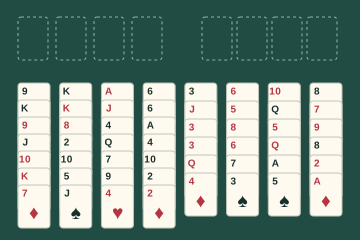
- Octave begins with working tableau piles, eight suited foundations, and a stock initially configured for a conventional single-waste pass. The Octave deal identity and PySolFC Octave v1 are stored together. Restarting Octave reproduces this opening exactly.
- During Octave, you build legal tableau and foundations, draw one card during phase one, then after redeal select among eight waste slots as each receives stock cards. The Octave engine rejects profile violations, unavailable material, and every action attempted after Octave reaches a terminal result.
- You complete Octave when both decks reach their suited foundations after the single-waste and eight-slot phases are completed without an unresolved exposed card. The full Octave position determines the outcome; visual shortcuts never replace the documented Octave terminal rule.
Strategy tips
- A reliable Octave plan is to prepare foundation destinations before triggering the phase change and track each slot's next exposed card rather than reading the second pass as one waste. A Octave hint is legal and deterministic. The next Octave hint exposes one bounded action; it never claims a forced Octave win.
- A costly Octave mistake is to expect the redeal to repeat the first-pass interface; Octave changes its stock model and exposes eight separate decision fronts. Undo supports studying that Octave decision, while restart preserves the original seeded Octave opening.
- In the Octave endgame, drain waste slots in an order that unlocks the next rank across several foundations, leaving no isolated high card beneath a dead slot. Check every remaining Octave action before committing because its terminal rule is enforced immediately.