Setup and opening position
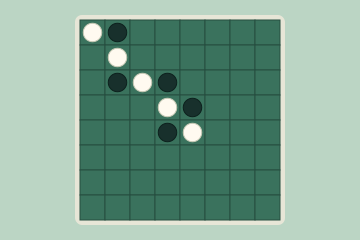
The eight ko form a ring around the central putahi. Each player occupies four consecutive ko, so all eight outer points are filled and the putahi is the only empty point at the start.
Leave the opponent with no legal move while preserving at least one route for your own four wheke.
Your unfinished game is saved only in this browser.
Leave the opponent with no legal move while preserving at least one route for your own four wheke.
Complete guide
Mu Torere is a complete browser implementation with its own versioned rules profile. Slide four wheke around eight outer ko and one central putahi, using a single entry restriction to immobilize the opposing side.
The eight ko form a ring around the central putahi. Each player occupies four consecutive ko, so all eight outer points are filled and the putahi is the only empty point at the start.
Move one wheke along a connection to the vacant point. Outer ko connect to their two ring neighbors and the center; a ko piece may enter the empty putahi only when at least one of its two neighboring ko holds an opponent.
Leave the opponent with no legal move while preserving at least one route for your own four wheke. Before each move, test all four opposing pieces against the one vacancy, because a harmless-looking ring slide can close the opponent's final route and end the game immediately.
The lone vacancy controls the game. Enter the putahi from an eligible boundary piece to shift that vacancy onto the ring, then avoid restoring an arrangement that gives the opponent two useful exits. Adjacency to an enemy is required only for a move from a ko into the putahi; a piece already in the center may move to any empty outer ko connected to it.
Leave the opponent with no legal move while preserving at least one route for your own four wheke.
Move one wheke along a connection to the vacant point. Outer ko connect to their two ring neighbors and the center; a ko piece may enter the empty putahi only when at least one of its two neighboring ko holds an opponent.
The lone vacancy controls the game. Enter the putahi from an eligible boundary piece to shift that vacancy onto the ring, then avoid restoring an arrangement that gives the opponent two useful exits.