Genesis

You complete Genesis when every card reaches the required foundation under this profile's rank, suit, direction, and access constraints. The engine evaluates the full position rather than relying on a visual shortcut or an unsupported solvability claim.

Loading game

Stats on this device

Your unfinished game is saved only in this browser.

Played
0
Wins
0
Win rate
Fastest win
Fewest moves
Best score
Current streak
0 days
Best streak
0 days

How to play

You complete Genesis when every card reaches the required foundation under this profile's rank, suit, direction, and access constraints. The engine evaluates the full position rather than relying on a visual shortcut or an unsupported solvability claim.

  • Genesis opens from a versioned seeded position built for Thirteen open columns feed suit foundations whose arbitrary rank order must remain synchronized across all suits. Its game ID, rules profile, and deal identity are stored together so restart recreates the same opening without a server request.
  • Every Genesis action is checked against the current board, available material, and this defining restriction: Thirteen open columns feed suit foundations whose arbitrary rank order must remain synchronized across all suits. Invalid, stale, or post-terminal actions leave the position unchanged.
  • You complete Genesis when every card reaches the required foundation under this profile's rank, suit, direction, and access constraints. The engine evaluates the full position rather than relying on a visual shortcut or an unsupported solvability claim.

Strategy tips

  • A practical Genesis plan is to preserve several legal continuations around Thirteen open columns feed suit foundations whose arbitrary rank order must remain synchronized across all suits. Use the deterministic hint to inspect one legal action, then compare how it affects the documented objective before committing.
  • A common Genesis error is to ignore the boundary rule that Thirteen open columns feed suit foundations whose arbitrary rank order must remain synchronized across all suits. Undo is useful for studying that decision, while restart deliberately preserves the original seeded position.
  • Near the end of Genesis, recount the remaining obligations needed until every card reaches the required foundation under this profile's rank, suit, direction, and access constraints. Check the boundary rule after every final placement or transfer because terminal status is enforced immediately.
Complete guide

Rules, scoring, and strategy

Genesis uses the independently implemented Genesis PySolFC 3.6.1 rules profile v1 profile (R385). Genesis is a complete deterministic browser game whose distinct rules centre on Thirteen open columns feed suit foundations whose arbitrary rank order must remain synchronized across all suits.

Setup and opening position

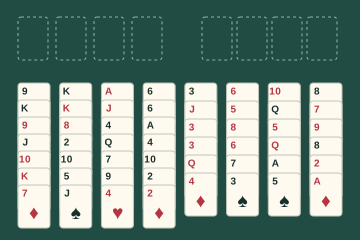
Genesis opens from a versioned seeded position built for Thirteen open columns feed suit foundations whose arbitrary rank order must remain synchronized across all suits. Its game ID, rules profile, and deal identity are stored together so restart recreates the same opening without a server request.

Legal moves and game flow

Every Genesis action is checked against the current board, available material, and this defining restriction: Thirteen open columns feed suit foundations whose arbitrary rank order must remain synchronized across all suits. Invalid, stale, or post-terminal actions leave the position unchanged.

Winning and terminal positions

You complete Genesis when every card reaches the required foundation under this profile's rank, suit, direction, and access constraints. The engine evaluates the full position rather than relying on a visual shortcut or an unsupported solvability claim. Near the end of Genesis, recount the remaining obligations needed until every card reaches the required foundation under this profile's rank, suit, direction, and access constraints. Check the boundary rule after every final placement or transfer because terminal status is enforced immediately.

Practical strategy

A practical Genesis plan is to preserve several legal continuations around Thirteen open columns feed suit foundations whose arbitrary rank order must remain synchronized across all suits. Use the deterministic hint to inspect one legal action, then compare how it affects the documented objective before committing. A common Genesis error is to ignore the boundary rule that Thirteen open columns feed suit foundations whose arbitrary rank order must remain synchronized across all suits. Undo is useful for studying that decision, while restart deliberately preserves the original seeded position.

Questions players ask

What makes Genesis a separate game?

Genesis has its own runtime and save identity because its rules require Thirteen open columns feed suit foundations whose arbitrary rank order must remain synchronized across all suits.

Which Genesis edge rule matters most?

Thirteen open columns feed suit foundations whose arbitrary rank order must remain synchronized across all suits.

Can a Genesis position be reproduced?

Genesis stores its game ID, rules version, and seeded deal identity. Those values recreate the same opening locally without promising that the position is forced or winnable.