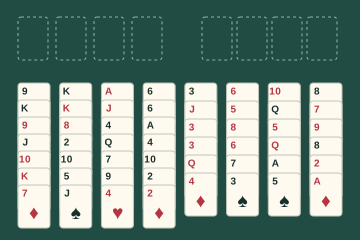
How to play
You complete Firing Squad when only the four Aces remain in the working area after forty-eight lower cards have been eliminated under the comparison rule. The full Firing Squad position determines the outcome; visual shortcuts never replace the documented Firing Squad terminal rule.
- Firing Squad begins with four working piles, a stock dealing one row at a time, protected isolation cells, and an empty discard record for legally eliminated cards. The Firing Squad deal identity and PySolFC Firing Squad v1 are stored together. Restarting Firing Squad reproduces this opening exactly.
- During Firing Squad, you remove an exposed lower same-suit card when a higher peer is exposed, deal another row, or move a working card into a free isolation cell. The Firing Squad engine rejects profile violations, unavailable material, and every action attempted after Firing Squad reaches a terminal result.
- You complete Firing Squad when only the four Aces remain in the working area after forty-eight lower cards have been eliminated under the comparison rule. The full Firing Squad position determines the outcome; visual shortcuts never replace the documented Firing Squad terminal rule.
Strategy tips
- A reliable Firing Squad plan is to use an isolation cell only to open a decisive comparison and identify the empty working pile needed to bring that isolated card back. A Firing Squad hint is legal and deterministic. The next Firing Squad hint exposes one bounded action; it never claims a forced Firing Squad win.
- A costly Firing Squad mistake is to expect a cell card to eliminate or be eliminated; isolation deliberately suspends comparison until the card returns to an empty working pile. Undo supports studying that Firing Squad decision, while restart preserves the original seeded Firing Squad opening.
- In the Firing Squad endgame, release isolated cards before the final stock row, then order same-suit comparisons so each Ace survives as its suit's highest card. Check every remaining Firing Squad action before committing because its terminal rule is enforced immediately.