Eclipse

Complete Eclipse when all cards have reached foundations in the profile's required rank, suit, colour, direction, source and capacity order. The runtime checks the entire position rather than a visual approximation or an unsupported solvability claim.

Loading game

Stats on this device

Your unfinished game is saved only in this browser.

Played
0
Wins
0
Win rate
Fastest win
Fewest moves
Best score
Current streak
0 days
Best streak
0 days

How to play

Complete Eclipse when all cards have reached foundations in the profile's required rank, suit, colour, direction, source and capacity order. The runtime checks the entire position rather than a visual approximation or an unsupported solvability claim.

  • Eclipse reconstructs its published opening from the route ID, rules version and local seed. Fixed clues, hidden cards and editable decisions remain separate, and restart reproduces the same position without a network request.
  • A transfer is legal only under two decks open across thirteen same-suit descending columns with three concealed rounds and one exposed round; later stock actions deal one card to every column, and complete suit runs may move together toward eight ace-up suit foundations. Invalid, stale, non-finite and post-terminal actions leave the state and undo history unchanged.
  • Complete Eclipse when all cards have reached foundations in the profile's required rank, suit, colour, direction, source and capacity order. The runtime checks the entire position rather than a visual approximation or an unsupported solvability claim.

Strategy tips

  • Start Eclipse with the most constrained exposed obligation, then preserve a second legal route before committing the first. Two decks open across thirteen same-suit descending columns with three concealed rounds and one exposed round; later stock actions deal one card to every column, and complete suit runs may move together toward eight Ace-up suit foundations.
  • Do not treat a locally tidy move as proof of progress in Eclipse; it can consume the only route that still satisfies the full boundary rule.
  • Near the end of Eclipse, count every unresolved destination or constraint before committing a narrow move. Use undo to compare legal branches, then recheck that all cards have reached foundations in the profile's required rank, suit, colour, direction, source and capacity order.
Complete guide

Rules, scoring, and strategy

Eclipse uses the independently implemented Eclipse PySolFC 3.6.1 fixed rules v1 profile (R768). Eclipse is an independently versioned browser game centred on Two decks open across thirteen same-suit descending columns with three concealed rounds and one exposed round; later stock actions deal one card to every column, and complete suit runs may move together toward eight Ace-up suit foundations.

Setup and opening position

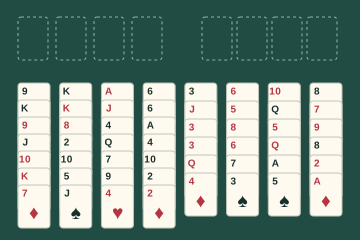
Eclipse reconstructs its published opening from the route ID, rules version and local seed. Fixed clues, hidden cards and editable decisions remain separate, and restart reproduces the same position without a network request.

Legal moves and game flow

A transfer is legal only under two decks open across thirteen same-suit descending columns with three concealed rounds and one exposed round; later stock actions deal one card to every column, and complete suit runs may move together toward eight ace-up suit foundations. Invalid, stale, non-finite and post-terminal actions leave the state and undo history unchanged.

Winning and terminal positions

Complete Eclipse when all cards have reached foundations in the profile's required rank, suit, colour, direction, source and capacity order. The runtime checks the entire position rather than a visual approximation or an unsupported solvability claim. Near the end of Eclipse, count every unresolved destination or constraint before committing a narrow move. Use undo to compare legal branches, then recheck that all cards have reached foundations in the profile's required rank, suit, colour, direction, source and capacity order.

Practical strategy

Start Eclipse with the most constrained exposed obligation, then preserve a second legal route before committing the first. Two decks open across thirteen same-suit descending columns with three concealed rounds and one exposed round; later stock actions deal one card to every column, and complete suit runs may move together toward eight Ace-up suit foundations. Do not treat a locally tidy move as proof of progress in Eclipse; it can consume the only route that still satisfies the full boundary rule.

Questions players ask

Why is Eclipse counted separately?

Eclipse owns a separate engine ID, save key and rules profile because Two decks open across thirteen same-suit descending columns with three concealed rounds and one exposed round; later stock actions deal one card to every column, and complete suit runs may move together toward eight Ace-up suit foundations.

What should be checked before a Eclipse move?

Start Eclipse with the most constrained exposed obligation, then preserve a second legal route before committing the first. Two decks open across thirteen same-suit descending columns with three concealed rounds and one exposed round; later stock actions deal one card to every column, and complete suit runs may move together toward eight Ace-up suit foundations. A transfer is legal only under two decks open across thirteen same-suit descending columns with three concealed rounds and one exposed round; later stock actions deal one card to every column, and complete suit runs may move together toward eight ace-up suit foundations.

Does Eclipse promise a winnable deal?

No. Its seed reproduces the opening and its engine proves legal state transitions, but the catalog makes no unsupported claim that every shuffled deal is solvable.