How to play
Complete Dieppe when all cards have reached foundations in the profile's required rank, suit, colour, direction, source and capacity order. The runtime checks the entire position rather than a visual approximation or an unsupported solvability claim.
- Dieppe reconstructs its published opening from the route ID, rules version and local seed. Fixed clues, hidden cards and editable decisions remain separate, and restart reproduces the same position without a network request.
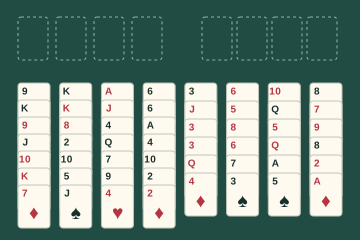
- A transfer is legal only under eight tableau lanes are paired with eight single-card reserves; clearing one lane changes which paired reserve card may enter the tableau before foundation play. Invalid, stale, non-finite and post-terminal actions leave the state and undo history unchanged.
- Complete Dieppe when all cards have reached foundations in the profile's required rank, suit, colour, direction, source and capacity order. The runtime checks the entire position rather than a visual approximation or an unsupported solvability claim.
Strategy tips
- Start Dieppe with the most constrained exposed obligation, then preserve a second legal route before committing the first. Eight tableau lanes are paired with eight single-card reserves; clearing one lane changes which paired reserve card may enter the tableau before foundation play.
- Do not treat a locally tidy move as proof of progress in Dieppe; it can consume the only route that still satisfies the full boundary rule.
- Near the end of Dieppe, count every unresolved destination or constraint before committing a narrow move. Use undo to compare legal branches, then recheck that all cards have reached foundations in the profile's required rank, suit, colour, direction, source and capacity order.