Deck

Deck is complete once pair removal leaves precisely four cards, one from each suit, as the terminal layout. The terminal check examines every relevant pile, cell, edge, room, and clue before awarding the result.
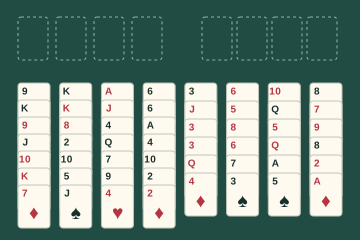
Loading game

Stats on this device

Your unfinished game is saved only in this browser.

Played
0
Wins
0
Win rate
Fastest win
Fewest moves
Best score
Current streak
0 days
Best streak
0 days

How to play

Deck is complete once pair removal leaves precisely four cards, one from each suit, as the terminal layout. The terminal check examines every relevant pile, cell, edge, room, and clue before awarding the result.

  • Deck starts with its fixed information already marked and its editable spaces left for the player. Four columns repeatedly remove exposed pairs of the same suit until exactly one survivor of each suit remains. Restart reconstructs the same opening from the stored game ID, rules version, and seed.
  • A move in Deck is accepted only while it preserves every already-visible requirement. Four columns repeatedly remove exposed pairs of the same suit until exactly one survivor of each suit remains. Failed validation leaves the move count, history, and board exactly as they were.
  • Deck is complete once pair removal leaves precisely four cards, one from each suit, as the terminal layout. The terminal check examines every relevant pile, cell, edge, room, and clue before awarding the result.

Strategy tips

  • Prefer same-suit removals that expose new pairs in two columns at once, and keep track of which suit already has a likely final survivor.
  • Removing any available pair without monitoring survivors can leave two cards of one suit and none of another, which cannot satisfy the four-suit finish.
  • At the end of Deck, recount the remaining destinations, marks, or connections before committing the narrowest move. The finish is accepted only when pair removal leaves precisely four cards, one from each suit, as the terminal layout.

Complete guide

Rules, scoring, and strategy

Deck uses the independently implemented Deck PySolFC 3.6.1 fixed rules v1 profile (R605). In Deck, the position revolves around this rule: Four columns repeatedly remove exposed pairs of the same suit until exactly one survivor of each suit remains.

Setup and opening position

Deck starts with its fixed information already marked and its editable spaces left for the player. Four columns repeatedly remove exposed pairs of the same suit until exactly one survivor of each suit remains. Restart reconstructs the same opening from the stored game ID, rules version, and seed.

Legal moves and game flow

A move in Deck is accepted only while it preserves every already-visible requirement. Four columns repeatedly remove exposed pairs of the same suit until exactly one survivor of each suit remains. Failed validation leaves the move count, history, and board exactly as they were.

Winning and terminal positions

Deck is complete once pair removal leaves precisely four cards, one from each suit, as the terminal layout. The terminal check examines every relevant pile, cell, edge, room, and clue before awarding the result. At the end of Deck, recount the remaining destinations, marks, or connections before committing the narrowest move. The finish is accepted only when pair removal leaves precisely four cards, one from each suit, as the terminal layout.

Practical strategy

Prefer same-suit removals that expose new pairs in two columns at once, and keep track of which suit already has a likely final survivor. Removing any available pair without monitoring survivors can leave two cards of one suit and none of another, which cannot satisfy the four-suit finish.

Questions players ask

When should players account for choosing the four final suit survivors in Deck?

Prefer same-suit removals that expose new pairs in two columns at once, and keep track of which suit already has a likely final survivor. This matters specifically because four columns repeatedly remove exposed pairs of the same suit until exactly one survivor of each suit remains.

What false assumption most often blocks Deck?

Removing any available pair without monitoring survivors can leave two cards of one suit and none of another, which cannot satisfy the four-suit finish. Recheck the legal boundary before choosing a replacement move.

How does Deck confirm the final position?

The winning condition for Deck is precise: pair removal leaves precisely four cards, one from each suit, as the terminal layout. No hidden solution values are printed to justify the result; the rules engine validates the submitted position. Undo and redo expose alternative branches without revealing an authored answer.