Contradance

Finish Contradance when both opposed foundation groups complete their prescribed lower and upper rank streams. Completion is checked from the entire position, not from a displayed answer or a visual approximation.

Loading game

Stats on this device

Your unfinished game is saved only in this browser.

Played
0
Wins
0
Win rate
Fastest win
Fewest moves
Best score
Current streak
0 days
Best streak
0 days

How to play

Finish Contradance when both opposed foundation groups complete their prescribed lower and upper rank streams. Completion is checked from the entire position, not from a displayed answer or a visual approximation.

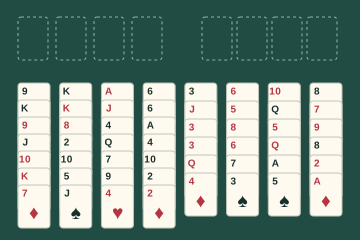
  • Read the opening of Contradance by locating every lane, clue, reserve, room, or fixed element named in its rule. Two groups of foundations split the deck into descending Five-through-A-then-K sequences and ascending Six-through-Queen sequences. The seeded deal and rules version reproduce that public starting information without exposing a hidden completion.
  • Check each proposed action against the current position and this boundary: Two groups of foundations split the deck into descending Five-through-A-then-K sequences and ascending Six-through-Queen sequences. Illegal, stale, and post-finish actions are rejected without changing the board.
  • Finish Contradance when both opposed foundation groups complete their prescribed lower and upper rank streams. Completion is checked from the entire position, not from a displayed answer or a visual approximation.

Strategy tips

  • Separate the lower descending stream from the upper ascending stream early, and preserve access to the Five/Ace/King transition cards that close each half.
  • Building only the visibly active half can bury a rank needed by the opposite bank, leaving neither the lower nor upper foundation stream able to advance.
  • During the final few decisions, compare every unresolved obligation with the target: both opposed foundation groups complete their prescribed lower and upper rank streams. Keep the option described in the strategy note available until the last forced dependency is settled.
Complete guide

Rules, scoring, and strategy

Contradance uses the independently implemented Contradance PySolFC 3.6.1 fixed rules v1 profile (R580). Contradance is defined by one exact interaction: Two groups of foundations split the deck into descending Five-through-A-then-K sequences and ascending Six-through-Queen sequences.

Setup and opening position

Read the opening of Contradance by locating every lane, clue, reserve, room, or fixed element named in its rule. Two groups of foundations split the deck into descending Five-through-A-then-K sequences and ascending Six-through-Queen sequences. The seeded deal and rules version reproduce that public starting information without exposing a hidden completion.

Legal moves and game flow

Check each proposed action against the current position and this boundary: Two groups of foundations split the deck into descending Five-through-A-then-K sequences and ascending Six-through-Queen sequences. Illegal, stale, and post-finish actions are rejected without changing the board.

Winning and terminal positions

Finish Contradance when both opposed foundation groups complete their prescribed lower and upper rank streams. Completion is checked from the entire position, not from a displayed answer or a visual approximation. During the final few decisions, compare every unresolved obligation with the target: both opposed foundation groups complete their prescribed lower and upper rank streams. Keep the option described in the strategy note available until the last forced dependency is settled.

Practical strategy

Separate the lower descending stream from the upper ascending stream early, and preserve access to the Five/Ace/King transition cards that close each half. Building only the visibly active half can bury a rank needed by the opposite bank, leaving neither the lower nor upper foundation stream able to advance.

Questions players ask

How should players account for the split lower and upper foundation streams in Contradance?

Separate the lower descending stream from the upper ascending stream early, and preserve access to the Five/Ace/King transition cards that close each half. This matters specifically because two groups of foundations split the deck into descending Five-through-A-then-K sequences and ascending Six-through-Queen sequences.

Which error should be checked first in Contradance?

Building only the visibly active half can bury a rank needed by the opposite bank, leaving neither the lower nor upper foundation stream able to advance. Recheck the legal boundary before choosing a replacement move.

What proves that Contradance is finished?

Contradance is complete once both opposed foundation groups complete their prescribed lower and upper rank streams. The terminal check examines every relevant pile, cell, edge, room, and clue before awarding the result. Undo and redo expose alternative branches without revealing an authored answer.