How to play
You complete Capricieuse when all 104 cards reach the suited foundations before the second tableau redeal is consumed. The full Capricieuse position determines the outcome; visual shortcuts never replace the documented Capricieuse terminal rule.
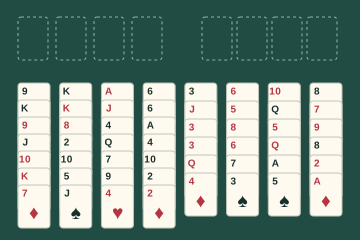
- Capricieuse begins with two decks distributed across open tableau piles with paired suited foundations and two deterministic redeals available. The Capricieuse deal identity and PySolFC Capricieuse v1 are stored together. Restarting Capricieuse reproduces this opening exactly.
- During Capricieuse, you place a same-suit adjacent rank in either direction, move exposed legal cards, advance foundations, or collect the current layout for an ordered redeal. The Capricieuse engine rejects profile violations, unavailable material, and every action attempted after Capricieuse reaches a terminal result.
- You complete Capricieuse when all 104 cards reach the suited foundations before the second tableau redeal is consumed. The full Capricieuse position determines the outcome; visual shortcuts never replace the documented Capricieuse terminal rule.
Strategy tips
- A reliable Capricieuse plan is to commit each exposed suit fragment to one direction and redeal only after every move that shortens or joins a fragment has been made. A Capricieuse hint is legal and deterministic. The next Capricieuse hint exposes one bounded action; it never claims a forced Capricieuse win.
- A costly Capricieuse mistake is to trigger a redeal as a harmless refresh; Capricieuse has only two, and collection order determines the next layout exactly. Undo supports studying that Capricieuse decision, while restart preserves the original seeded Capricieuse opening.
- In the Capricieuse endgame, join complementary up-and-down suit fragments before the last collection, then direct exposed middle ranks to balanced foundations. Check every remaining Capricieuse action before committing because its terminal rule is enforced immediately.