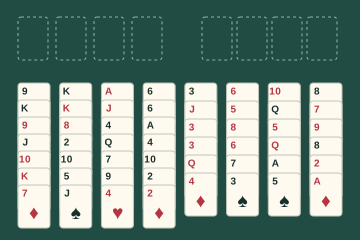
Setup and opening position
Two decks provide a twenty-card braid, twelve one-card reserves, a shared-base card on one of eight foundations, one waste card, and a stock. The first four reserves are braid outlets; the other eight are helper cells.
Move both decks to eight suited, consistently directed foundations.
Move both decks to eight suited, consistently directed foundations.
Complete guide
Braid Solitaire is a complete browser implementation with its own versioned rules profile. Release a twenty-card braid through four auto-filled outlets and build wrapped foundations in one chosen direction.
Two decks provide a twenty-card braid, twelve one-card reserves, a shared-base card on one of eight foundations, one waste card, and a stock. The first four reserves are braid outlets; the other eight are helper cells.
Foundations are paired by suit and start at the common base rank. The second card placed chooses ascending or descending wrap for every foundation. Empty braid outlets refill automatically from the auxiliary braid; a waste card may occupy an empty helper cell. Draw singly and use at most two redeals.
Move both decks to eight suited, consistently directed foundations. Empty the braid outlets first, then release helper-cell cards during the final stock pass in the chosen wrapped order.
Delay fixing the direction until the exposed braid, reserve, and waste ranks clearly favor one side of the base. Once a second foundation card fixes the direction, no foundation may reverse it; the eight helper cells also hold only one card each.
Move both decks to eight suited, consistently directed foundations.
Foundations are paired by suit and start at the common base rank. The second card placed chooses ascending or descending wrap for every foundation. Empty braid outlets refill automatically from the auxiliary braid; a waste card may occupy an empty helper cell. Draw singly and use at most two redeals.
Delay fixing the direction until the exposed braid, reserve, and waste ranks clearly favor one side of the base.